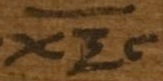
Greek Hebrew English Gematria/Isopsephy with Missing Samekh

9+9+9=27 but English alphabet only has 26 letters
The (Old) 27th Letter of the English Alphabet is &
1st Witness

A
Alpha
B
Beta
C/g
Gamma
Christ
God
D
Delta
E
Epsilon
Ϝ ϝ / Ϛ ϛ
Digamma Stigma
س
G/c
Zeta
God
Christ
H
Eta
I/j
Θθ Theta
Theos    Θεός
Theos=God
in english
1
2
3
4
5
6
7
8
9
J/i
iota
Jesus
K
Kappa
Krist
L
Lambda
Lamb
M
Mu
N
Nu
Samekhi
𐤎
س
ס

Ξ

O
Omicron
P
Pi
Q
Koppa
10
20
30
40
50
60
70
80
90
R
Rho
S
Sigma
Σ

T
Tau
U
Upsilon
V
Phi
W
UU/VV
Chi
س
X
Ψ ψ
Psi
Xi
Y
Ω ω
Omega
Z
Ϡ
Sampi
Zeus
Zeta
100
200
300
400
500
600
700
800
900


666
  1. The Nomina Sacra found in the earliest Greek texts, including: ΘΣ, (Θεός, God), ΙΣ (Jesus), ΧΣ (Χριστός - Christ) ΣΗΡ (Savior), ΚΣ ( Κύριος - Lord), ΥΣ (Υἱός - Son), ΣΤΣ (Σταυρός - cross)

  2. Θ Theta was considered also the symbol of death. In classical Athens, it was used as an abbreviation for the Greek θάνατος (thanatos, “death”) and as it vaguely resembles a human skull, theta was used as a warning symbol of death, in the same way that skull and crossbones are used in modern times.

  3. In Ancient Greek, 'Χ' and 'Ψ' were among several variants of the same letter, used originally for /kʰ/ and later, in western areas such as Arcadia, as a simplification of the digraph 'ΧΣ' for /ks/.

  4. The shape ς and alphabetic position of Sigma is derived from the Phoenician letter W (shin).

  5. While the letter shape S aka Σ continues Phoenician shin, its name sigma is taken from the letter samekh, while the shape and position of samekh but name of shin is continued in the xi.

  6. The letter W appeared in print as a unique letter 'W' in 1700

  7. Digamma, waw, or wau (uppercase: Ϝ, lowercase: ϝ, numeral: ϛ) is an archaic letter of the Greek alphabet. It originally stood for the sound /w/ but it has remained in use principally as a Greek numeral for 6. The name "stigma" (στίγμα) was originally a common Greek noun meaning "a mark, dot, puncture" or generally "a sign", from the verb στίζω ("to puncture").

  8. As the final letter in the Greek alphabet, omega is often used to denote the last, the end, or the ultimate limit of a set, in contrast to alpha, the first letter of the Greek alphabet; see Alpha and Omega.

  9. Xi is the 14th letter of the Greek alphabet. It is pronounced in Modern Greek, and generally or in English. In the system of Greek numerals, it has a value of 60. Xi was derived from the Phoenician letter samekh. Xi is distinct from the letter chi, which gave its form to the Latin letter X

  10. Samekh has no continuant in the Arabic alphabet, its numerical value 3000 is taken by Arabic Šīn. However the Nabataean alphabet, which is the direct ancestor to the Arabic alphabet, contained the letter ס Simkath


 In Talmudic legend, samekh ס is said to have been a miracle of the Ten Commandments. Exodus 32:15 records that the tablets "were written on both their sides." The Jerusalem Talmud interprets this as meaning that the inscription went through the full thickness of the tablets. The stone in the center parts of the letters ayin and teth should have fallen out, as it was not connected to the rest of the tablet, but it miraculously remained in place

Will the Samekhi->0 be unbroken

By and by, Lord, by and by

There's a better home a-waiting

In the sky, Lord, in the sky